The short version
- Ads are live in ChatGPT in India for logged-in adults on the Free and Go plans. Self-serve buying opened on 31 August 2026, not 4 September. The floor is ₹725 a day, about ₹21,750 a month.
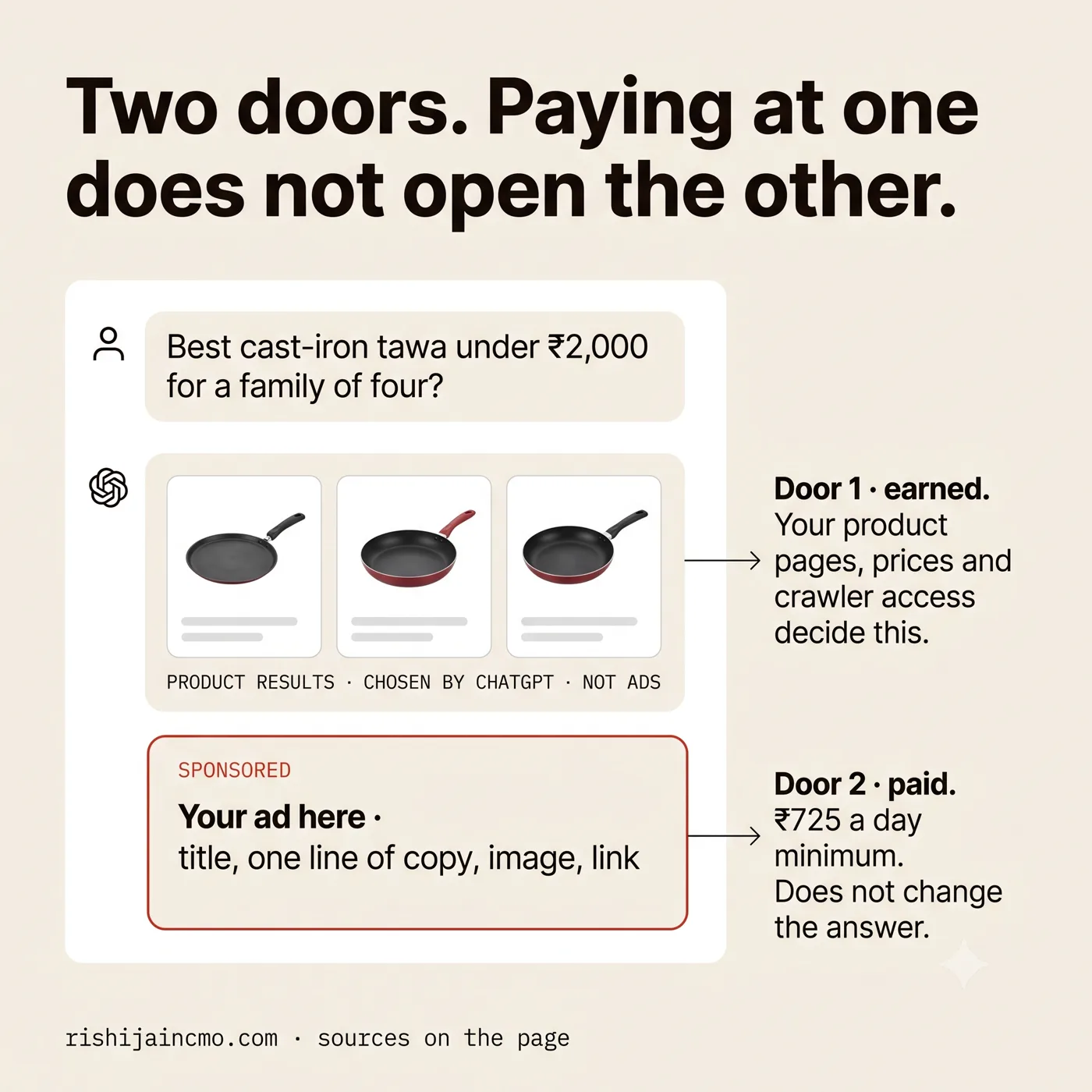
- The ad sits below the answer, labelled. It does not change the answer. Paying does not get your brand recommended.
- At the floor, first orders do not pay for the clicks unless a click costs ₹5 to ₹24. OpenAI's US guidance is $3 to $5 a click.
- So the floor buys price discovery, not sales. Run it for thirty days as research, judged on click price and add-to-cart rate, never on orders.
- Pass four gates first: category, claims, page, money. And do the free work first: unblock the crawlers, fix the product pages, get into Google's AI shopping, which is already live in India in English and Hindi.
What changed, in four dates
What changed, in four dates.
India · August 2026
Text version of this figure
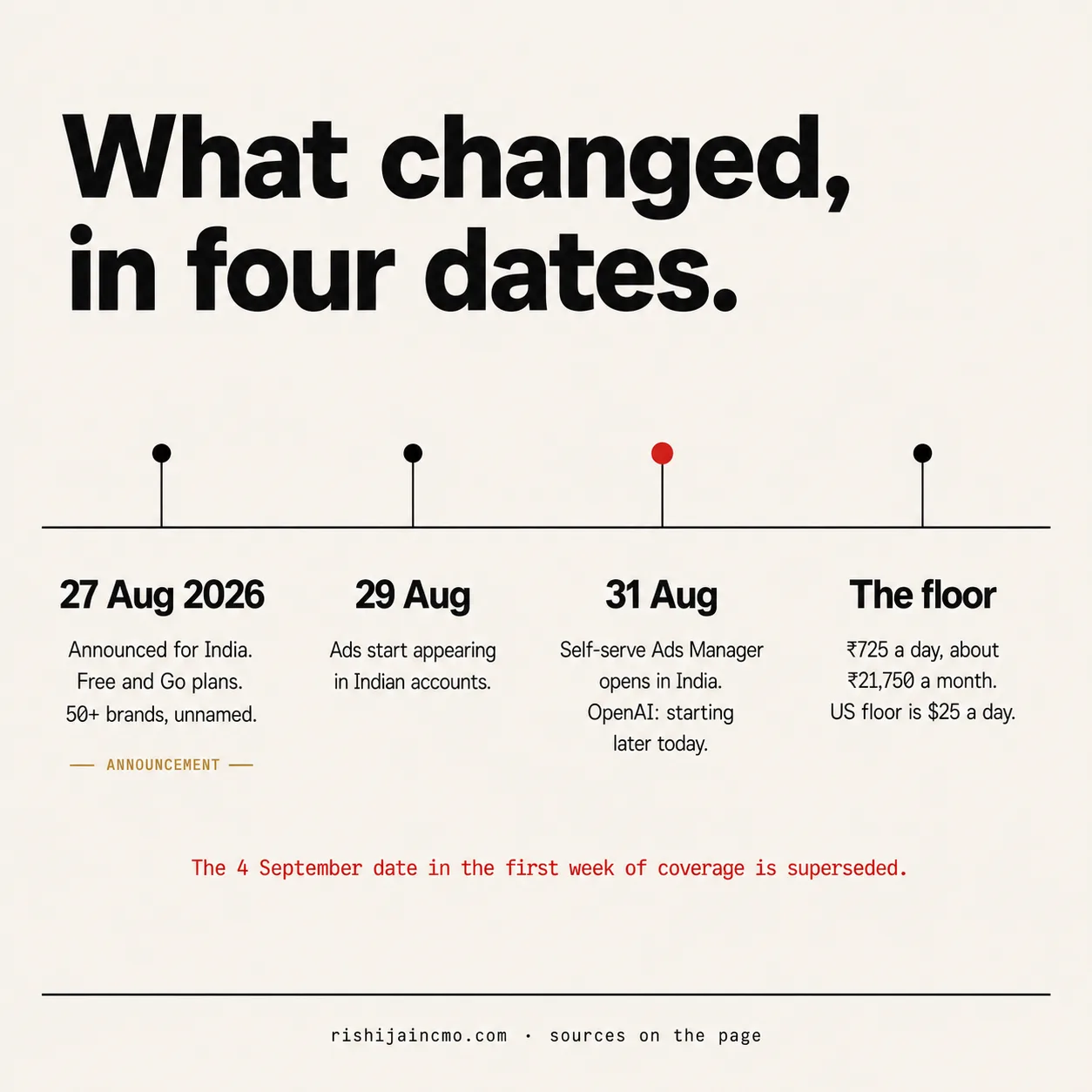
On 27 August 2026 OpenAI announced ads inside ChatGPT for India, with "more than 50 brands" in launch week and WPP and Omnicom as the first agency partners (TechCrunch, 27 Aug 2026). Not one of those fifty has been named in any Indian outlet. Any list you see is invented.
Ads began appearing in Indian accounts around 29 August (PPC Land, 29 Aug 2026).
On 31 August OpenAI's own post said: "Starting later today, advertisers can purchase ChatGPT ads directly via Ads Manager across India, Europe, the Middle East, and North Africa" (OpenAI, 31 Aug 2026). The first week's coverage said 4 September. The primary source wins. You can open an account today.
The floor is in OpenAI's own minimum-spend table: India 725 INR a day (OpenAI Help Center, read 3 Sep 2026). The US floor is 25 dollars. Thirty days at the floor is ₹21,750. A daily budget is a seven-day average, so you can be billed up to ₹1,450 on one day, and never more than ₹5,075 in any seven.
The scale behind it is real. OpenAI reports "$1 billion in annualized revenue run rate" in under 200 days, "tens of thousands of advertisers" and more than a billion weekly users worldwide (OpenAI, 31 Aug 2026). India has more than 100 million weekly users and is its second-largest market (TechCrunch, 27 Aug 2026).
How the ad actually works
Two doors. Paying at one does not open the other.
Where the ad sits, and where it does not
Text version of this figure
ChatGPT answer
For a family of four, a 12-inch pre-seasoned tawa is the usual pick. Three that fit the budget:Product results · chosen by ChatGPT · not ads
Sponsored
Your ad here · one title, one line of copy, an image, a link to a product page.Where it sits. A sponsored card below the answer, labelled and visually separate. OpenAI's words: "Advertising does not influence the answers ChatGPT provides." The product results ChatGPT shows inside an answer are a different system, "selected independently by ChatGPT and are not ads" (OpenAI Help, updated late Aug 2026). Two doors. Paying at one does not open the other.
What triggers it. The context and intent of the current conversation, plus your landing page, title, copy and hints. When a user has personalisation switched on, the system may also use "past chats and memory". Users can turn that off at Settings > Ad Controls. Advertisers never see a conversation (OpenAI Help, read 3 Sep 2026).
Who sees it. Adults on the Free and Go plans. Plus, Pro, Business, Enterprise and Edu stay ad-free. OpenAI India's managing director has said there will be no ads to under-18s or beside mental health or politics (Storyboard18, 30 Aug 2026).
How you buy. Three objectives: Views, billed per thousand impressions; Clicks, billed per click; Conversions, a conversion-optimised CPC that is still "per valid click, not per conversion". The auction sets the price. There is no rate card. The default automated bidding "does not guarantee delivery against a specific CPA, CPC, ROAS" (PPC Land, Aug 2026). OpenAI's US guidance is "a starting maximum bid of $3 to $5 USD per click" (PPC Land, 5 May 2026). No Indian clearing price has been published by anyone.
Targeting. Country level. States, cities and postcodes are documented for the US only; for India, assume all-India delivery until the location picker shows you otherwise. You can pick platforms: iOS app, Android app, web. Custom audiences need 25,000 matched users (OpenAI developers, read 3 Sep 2026), which most brands in this band do not have and, under Indian data law, should not be uploading anyway.
Creative and landing page. A title, a description, an image, a link. OpenAI asks for many distinct variations per product and benefit-led copy. The landing page must be a product or collection page, not the homepage, must carry your own tracking parameters, and "must not block OpenAI user agents (OAI-AdsBot and OAI-SearchBot)" (OpenAI Help, read 3 Sep 2026). Many Indian hosts and CDNs block AI crawlers by default. Check before you spend an hour on copy.
Money. A credit card, postpay, a temporary $100 verification hold, and charges whenever unpaid spend hits a threshold that starts low (OpenAI Help, read 3 Sep 2026). A pause "may take up to one business day to take effect", and a UK advertiser has already been refused a refund on that clause (The Register, 13 Aug 2026). OpenAI's measurements decide the bill. Disputes must be raised within 30 days and are settled in credits. The contract is with a US entity under California law, and any withholding tax is grossed up onto you (OpenAI advertising terms, 25 Aug 2026). One more line for your CA: the 6% equalisation levy on online ads ended on 1 April 2025 (Digital Policy Alert, Apr 2025), so the spend will most likely be treated as an import of services with 18% IGST under reverse charge on top, which can require GST registration whatever your turnover. Ask before the first invoice, not after.
What ₹725 a day actually buys
What ₹725 a day actually buys in a month.
₹21,750 a month · four assumed click prices · no Indian click price has been published
Text version of this figure
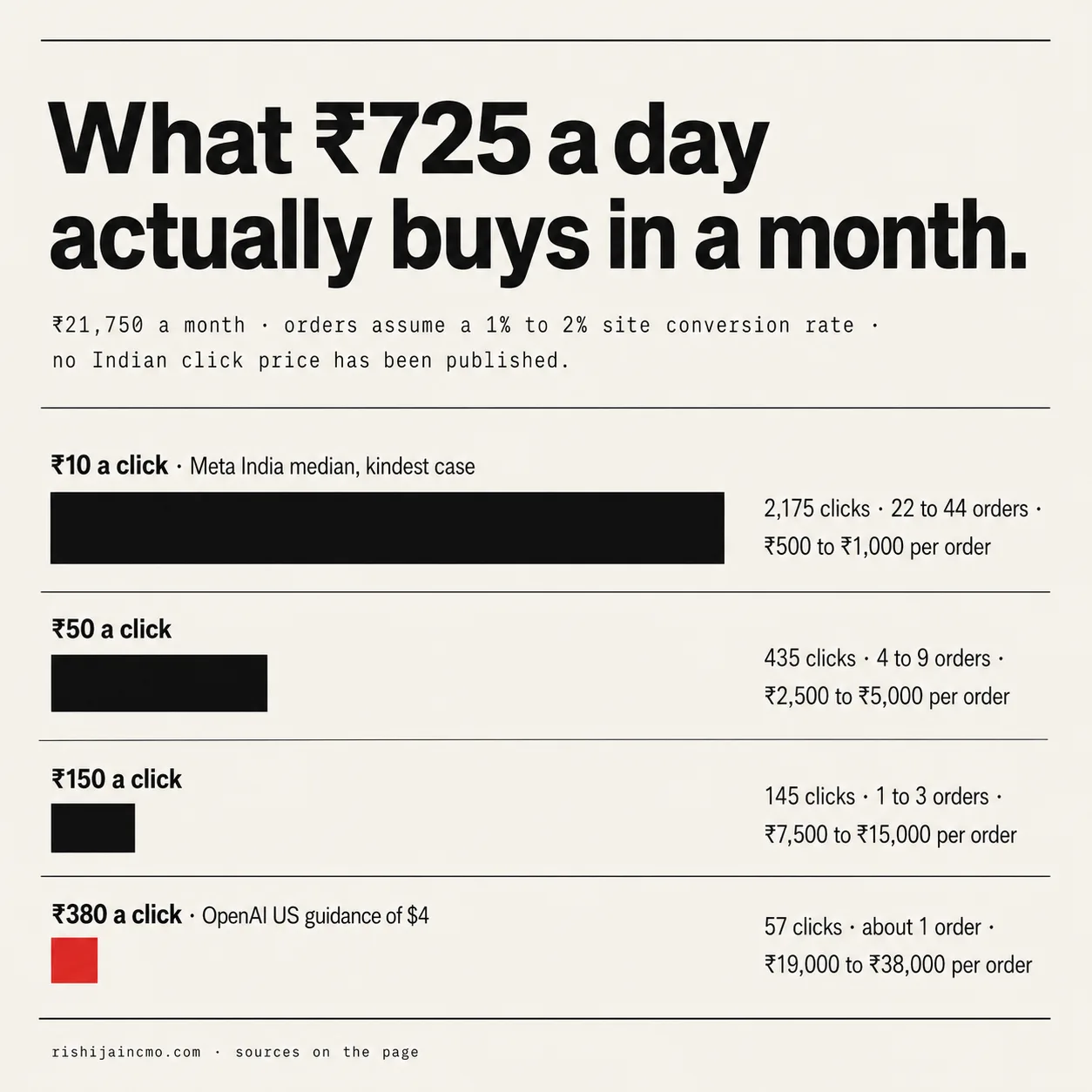
No Indian price exists, so the honest table shows four assumed click prices and lets you find your own row. The two conversion rates are assumptions too; use your own site's number. Everything else is arithmetic. The same numbers as a table:
| Click price (assumed) | Clicks a month | Orders at 1% site conversion | Orders at 2% | Cost per order at 1% | Cost per order at 2% |
|---|---|---|---|---|---|
| ₹10 (the Meta India median, the kindest case) | 2,175 | 22 | 44 | ₹1,000 | ₹500 |
| ₹50 | 435 | 4 | 9 | ₹5,000 | ₹2,500 |
| ₹150 | 145 | 1 | 3 | ₹15,000 | ₹7,500 |
| ₹380 (OpenAI's US guidance of $4, at ₹95) | 57 | 1 | 1 | ₹38,000 | ₹19,000 |
The Meta India median click price of about $0.10 comes from Superads' benchmark pages built on thousands of accounts, all verticals, and is the only India cost source found with a disclosed method. The exchange rate is the ECB reference of 2 September 2026.
The one number to compute before you open the account
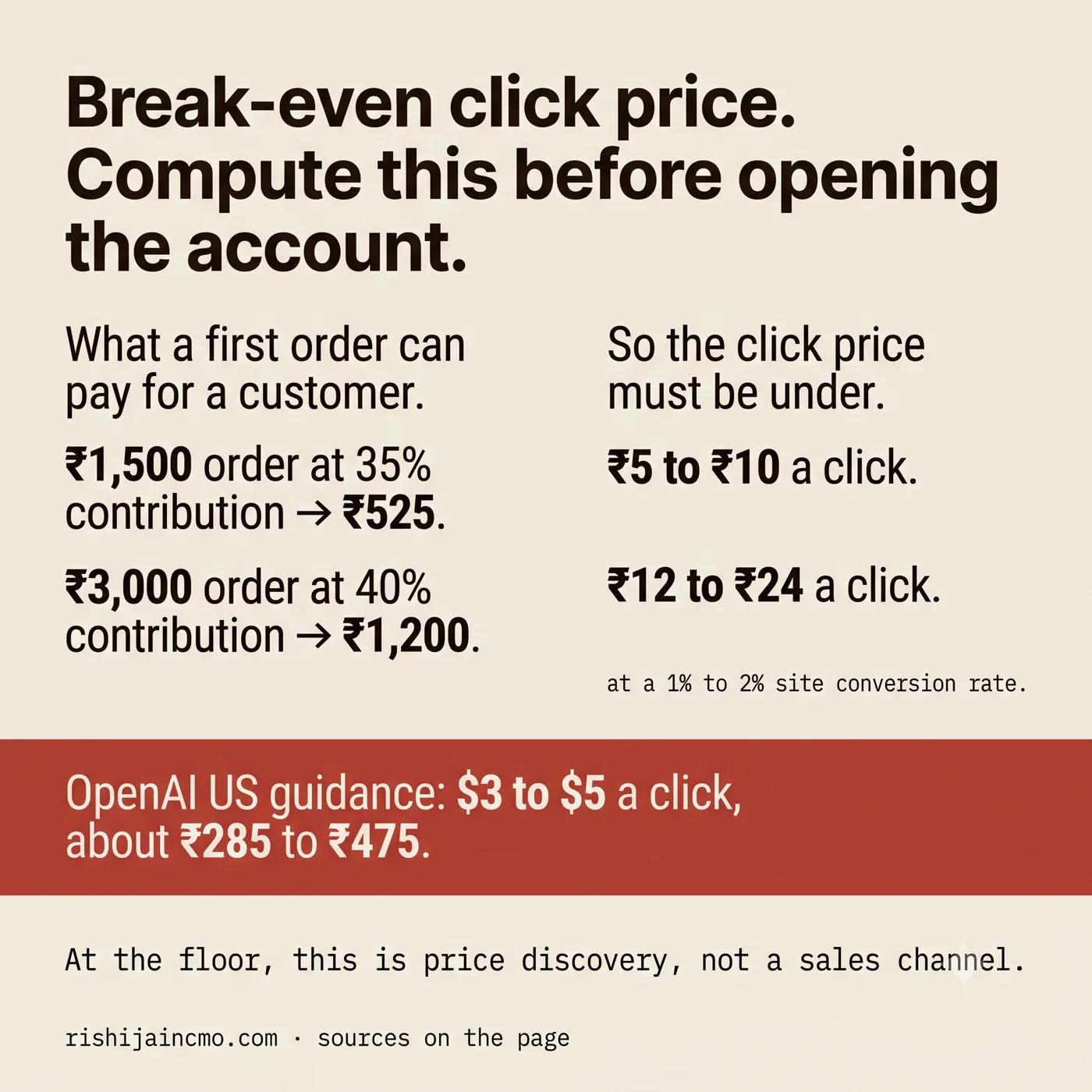
What a first order can pay for a customer is your order value times your contribution margin after goods, shipping, payment and returns. Divide that by your site's conversion rate and you have the click price at which the channel breaks even on the first order.
| Brand | Contribution per first order | Break-even click price at 1% | at 2% |
|---|---|---|---|
| ₹1,500 order, 35% contribution | ₹525 | ₹5 | ₹10 |
| ₹3,000 order, 40% contribution | ₹1,200 | ₹12 | ₹24 |
Read the two tables together. Unless India clears clicks near Meta's ₹10, the floor cannot pay for itself on first orders. Repeat purchase changes the answer, but only if your repeat rate is real and measured, not hoped.
The one number to compute first: your break-even click price.
What a first order can pay for a customer, divided by your site's conversion rate
Text version of this figure
Your own row in the table.
Four numbers in, four out. Nothing leaves this page.
What OpenAI's "3x return" example would need
OpenAI's post cites "an ecommerce advertiser achieving a 3x return on ad spend across its campaigns over 28 days". At the floor that is ₹65,250 of revenue from ₹21,750 of spend. For a ₹1,500-order brand that is 44 orders, which needs a 2% site at ₹10 clicks, a 10% site at ₹50, a 30% site at ₹150, or a 76% site at ₹380. For a ₹3,000-order brand, half those rates. The example is possible. It is possible only in the kindest row of the first table, and no one has yet shown that row exists in India.
What the measured data says so far
What the measured data says so far.
Third-party readings on US inventory · India not yet measured
- Click-through on US inventory has fallen as ad load rose: 0.91% in March, 0.68% in May, 0.50% in August 2026, by which point 26% of replies carried an ad (eMarketer, 27 Mar 2026; PPC Land, 17 Aug 2026).
- Across 50,000 prompts, 14.35% of ads were off-topic, and advertisers appeared inside the answer text itself only 3.63% of the time (eMarketer on SE Ranking, 13 Aug 2026).
- The only published small-advertiser tests found little: a Canadian agency got 58 clicks from 8,940 impressions at about CA$7 a click and zero leads; SE Ranking got a 1.30% click-through and "very few sign-ups" (Choice OMG, Aug 2026).
- ChatGPT sends about 0.2 to 0.32% of retail referral traffic. It converts 31% better than non-branded organic search at a 14% lower order value, and worse than affiliate and branded search (Search Engine Land, 26 Feb 2026). About 60% of those visits land on the homepage, not a product page.
- Indian intent is loud. BCG: 64% of Indian consumers use GenAI somewhere in the purchase journey (BCG, 2 Jan 2026). Accenture: 94% say they want to shop inside GenAI tools (Social Samosa, 15 Jul 2026). Indian behaviour is quieter: Bain, writing with Flipkart, says conversational commerce "is rarely used for end-to-end shopping today" (Bain, 8 Apr 2026).
The condition, named plainly: for a brand doing ₹1 to 50 crore, ChatGPT ads at the floor are a price-discovery instrument, not a sales channel. A thirty-day run produces between one and forty orders. It cannot tell a 1% site from a 2% site. It can tell you your real click price, your real click-through, and whether the visitors behave like buyers. That is worth ₹21,750 to some brands and to nobody twice.
The four gates, before you open ads.openai.com
Pass all four gates before you open ads.openai.com.
Any one failing means wait
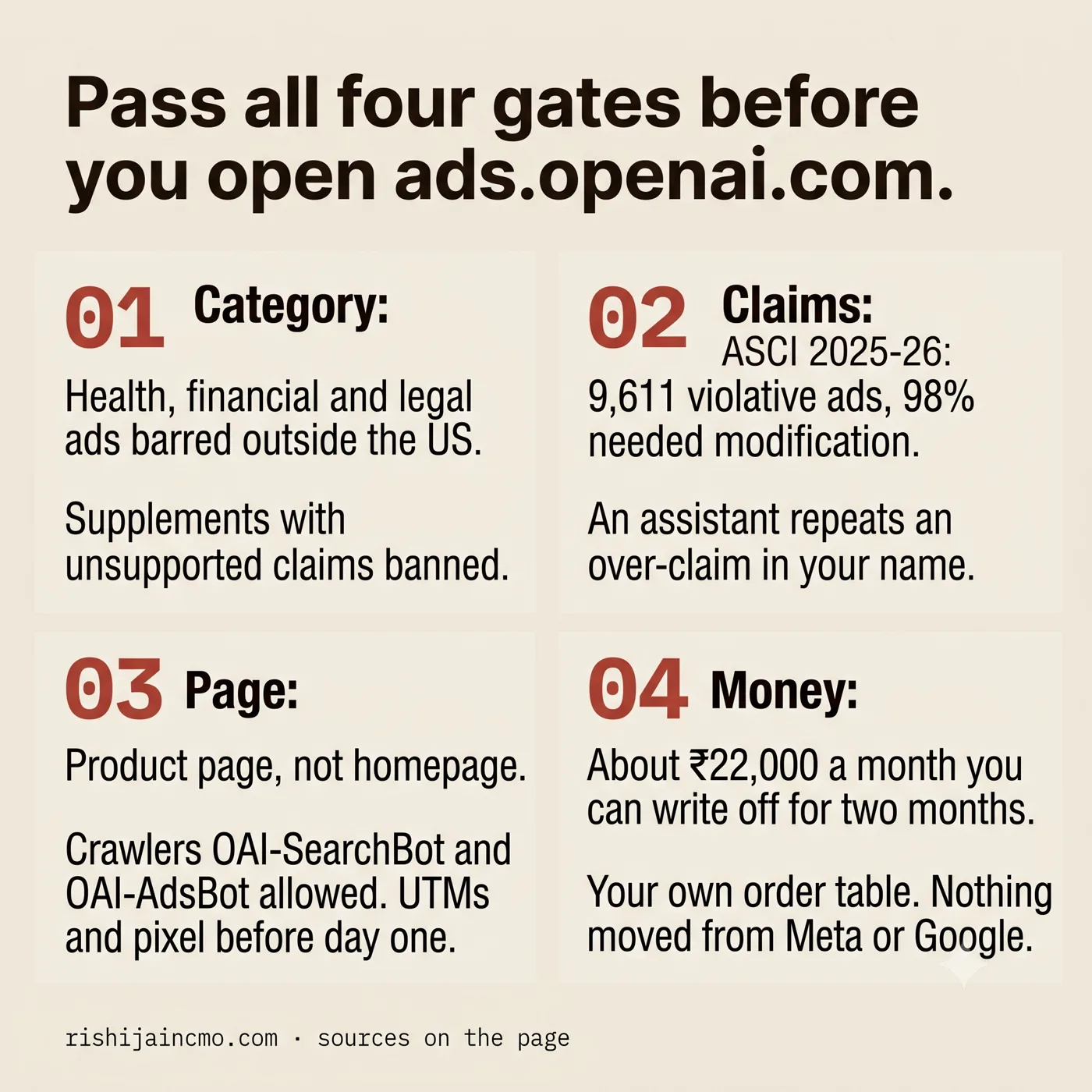
Text version of this figure
- Category. OpenAI's ad policy, updated 31 August 2026: ads for health services, financial services and legal services are "generally prohibited" outside the US, and supplements "marketed with unsupported health claims" are banned everywhere (OpenAI ad policies). Supplements, nutraceuticals, ayurveda, clinics, devices and fintech: the door is closed, whatever the budget.
- Claims. ASCI's FY 2025-26 report: 9,611 violative ads, 97% of them digital, 98% needing modification; nutraceuticals 96% modified; personal care 639 cases, 90% modified; 274 ayurveda ads referred under the Drugs and Magic Remedies Act (ASCI, May 2026). An assistant that reads an over-claimed page repeats the claim in your name, and the contract makes substantiation your job.
- Page. Product pages, not the homepage, with price, variants, shipping and cash-on-delivery stated. The two OpenAI crawlers allowed in robots.txt and at your CDN. Tracking parameters hard-coded into every ad link with utm_medium=cpc. The pixel or Conversions API installed before day one, or the Conversions objective is not available to you.
- Money. You can write off about ₹22,000 a month for two months without it mattering. You keep your own order table, because OpenAI's numbers are the billing authority and the only numbers you get. And you are not moving budget from Meta or Google to pay for it.
Who should test in September, and who should wait
Who should test in September, and who should wait.
By claims risk and ticket size, not by category glamour
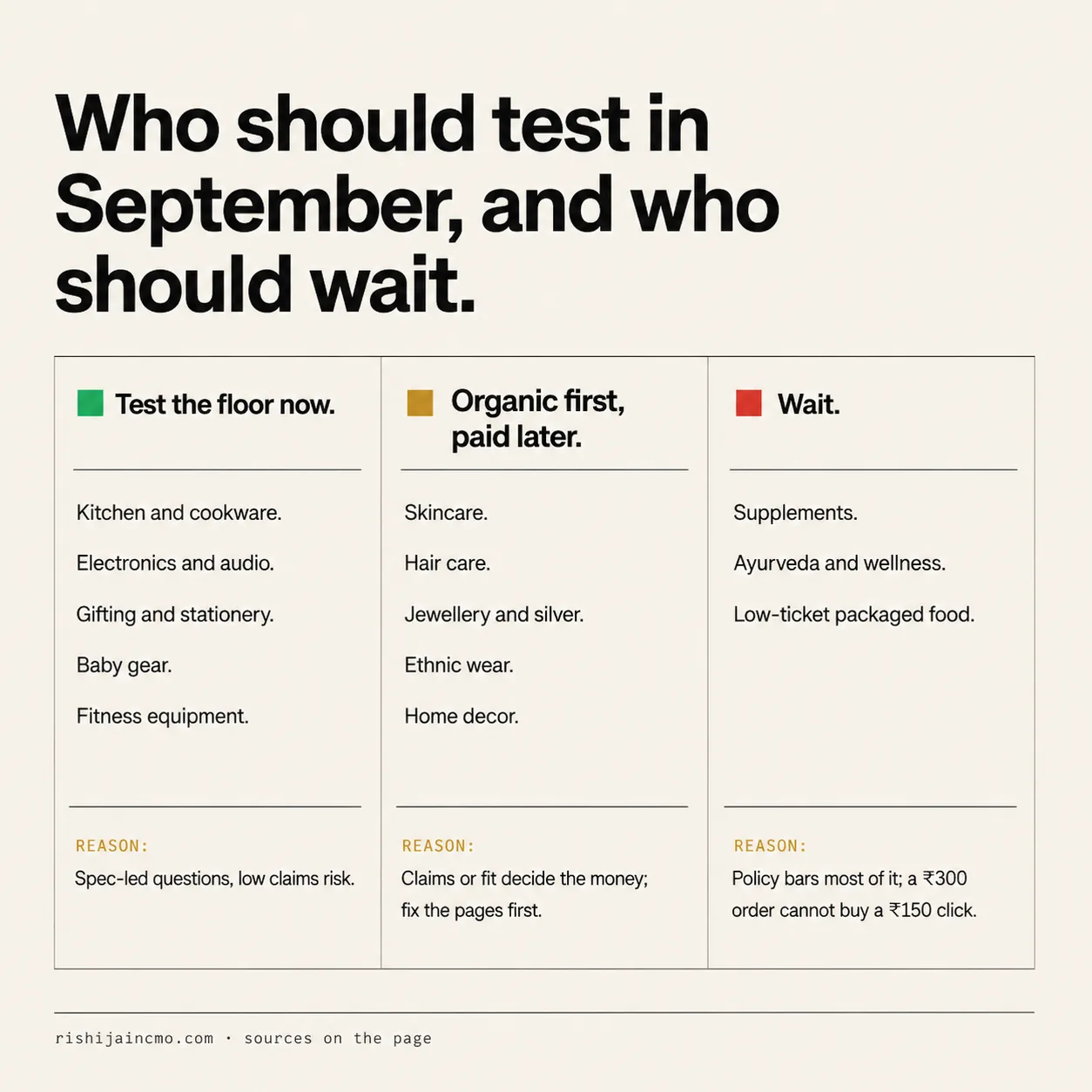
Text version of this figure
- Kitchen and cookware
- Electronics and audio
- Gifting and stationery
- Baby gear
- Fitness equipment
Spec-led questions, low claims risk. The question shape is native to a chat.
- Skincare
- Hair care
- Jewellery and silver
- Ethnic wear
- Home decor
High visibility in AI answers, but claims or fit decide the money. Fix the pages before buying traffic to them.
- Supplements
- Ayurveda and wellness
- Low-ticket packaged food
Policy bars most of it, ASCI modifies the rest, and a ₹300 order cannot buy a ₹150 click.
The category read leans on US visibility data (apparel 76%, electronics 70%, cosmetics 68%, grocery 59% of retail sites seeing LLM traffic, per Adobe via Digital Commerce 360, 19 Aug 2026) because no Indian category split exists yet. Treat it as a proxy.
The cheaper moves that come first
All five cost nothing but time, and they help whether or not you ever buy an ad.
- Unblock the crawlers. A site that opts out of OAI-SearchBot "will not be shown in ChatGPT search answers" (OpenAI developers). A study of fifty sites found 22% blocking at least one major AI crawler, usually by accident (Technori, 18 Aug 2026).
- Make the product page answer the unbranded question. Shopping results fire on 12.1% of open-ended prompts and only 3.1% of brand-name prompts (Profound, 3 Mar 2026). "Best X under ₹Y for Z" with real specs, prices and trade-offs is the page that gets cited. On buying prompts ChatGPT cites retailers and marketplaces 52.8% of the time and brand sites 14.7%; Reddit almost never (Shopify Community analysis, 9 Aug 2026).
- Check your Google eligibility. Ads inside Google's AI Overviews and AI Mode already serve in India from the Search, Shopping and Performance Max campaigns you run today, at no extra cost, though with no separate reporting (Google Ads Help). Put the catalogue into Merchant Center: Google's AI shopping is live in India in English and Hindi (Google India, 7 Apr 2026), while OpenAI's merchant feed "currently targets the US" (OpenAI commerce spec).
- Measure the free traffic first. GA4 has had an "AI Assistant" channel since 13 May 2026 (Google Analytics Help). Look at it for a month before you decide anything.
- Skip llms.txt. 97% of the files that publish one received zero traffic (Ahrefs, 15 Jun 2026). Spend the hour on plain-English titles and URLs, which are cited more (Ahrefs, 15 Apr 2026).
The category is probably still unclaimed. Only 15.2% of 1,094 product categories had a clear brand owner in AI answers, and branded search volume was the only significant predictor of who owned one (Search Engine Land, 21 Jul 2026). Small is not disqualifying here. Two independent stores out-cited Amazon 240 to 22 on their own category in the Shopify analysis above.
Measurement: decide it before the first impression
- Every ad link carries utm_source=chatgpt and utm_medium=cpc. Without it, paid clicks land in the same GA4 bucket as free citations and you will pay for traffic you already had.
- View-through conversions are excluded from the platform's Conversions column; judge on click-through only, and on your own order table.
- Write the kill rules down: stop at day 14 if the click price is above ten times your break-even and the add-to-cart rate is below your site average; stop at day 30 if cost per add-to-cart is worse than Meta's; continue only if both hold and at least one order traces back to a hard-coded UTM.
- In festive weeks, remember Criteo's Diwali 2024 reading across fifty Indian retailers: a median of 15 days from first product view to purchase. A seven-day window will call a working test a failure in October.
What I would do with ₹50,000 and thirty days.
For a brand that passes all four gates
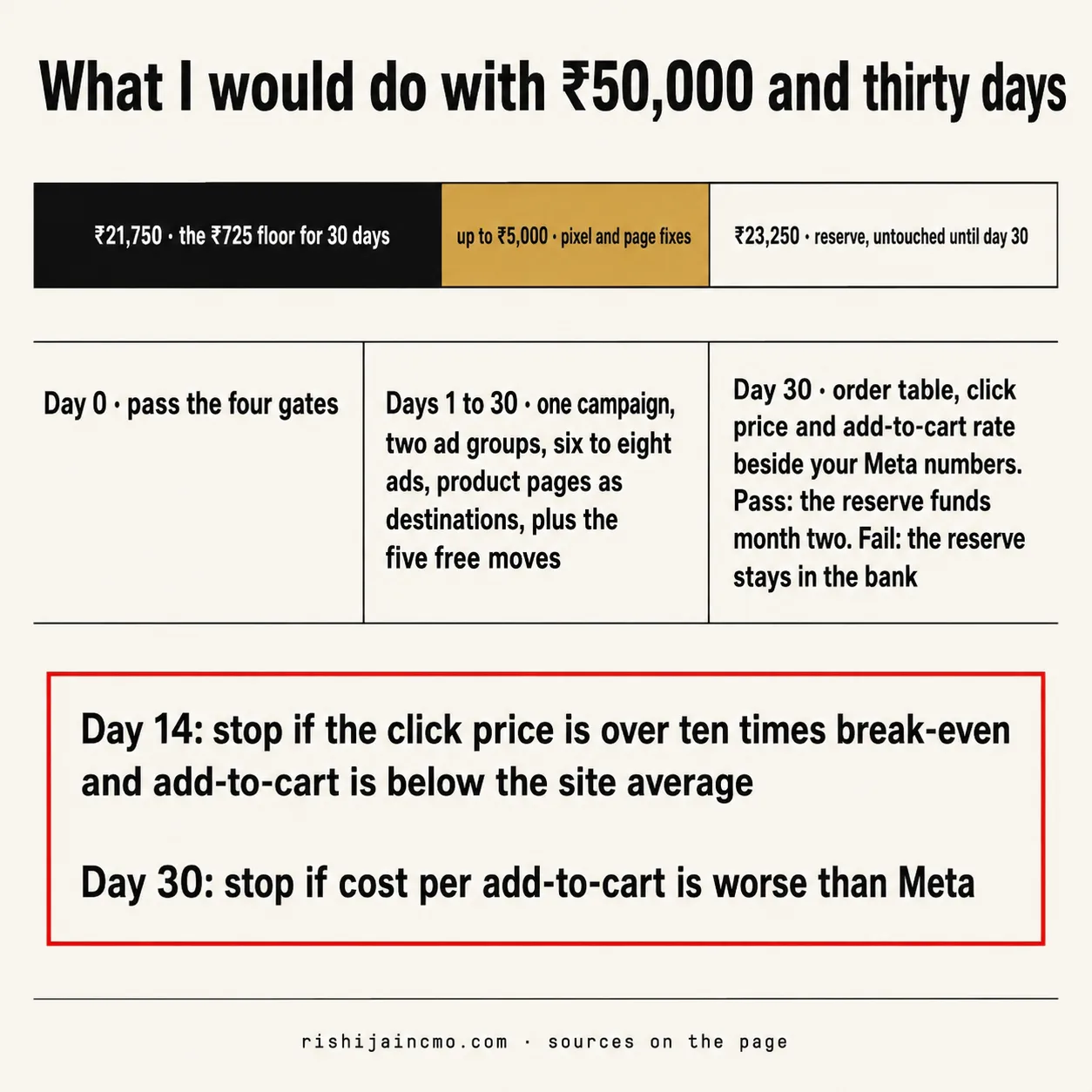
Text version of this figure
The ₹725 floor for 30 daysPixel and page fixes, up toReserve, untouched until day 30
What I would do with ₹50,000 and thirty days
Day 0: pass the four gates. One working day, ₹0 to ₹5,000 for the pixel. Days 1 to 30: the ₹725 floor, ₹21,750, one campaign, two ad groups, six to eight distinct ads, product pages as destinations. In parallel, at ₹0: the five cheaper moves. Reserve ₹23,000 and do not touch it. On day 30 put the order table, the click price and the add-to-cart rate beside your Meta numbers. If it passes, the reserve funds month two. If it fails, the reserve stays in the bank and the research becomes a page for your board. If your site converts under 1% on Meta traffic today, skip all of this and fix that first. I do not prescribe growth to a business that is still leaking. If you want a second pair of eyes on the numbers before you decide, Book a free 30-minute funnel review, and the 30-Day Leak Map is the study that prices the leak before you scale any spend.
Questions people ask
Are ChatGPT ads available in India?
Yes. Ads have shown to adults on the Free and Go plans since late August 2026, and self-serve buying through Ads Manager opened in India on 31 August 2026 according to OpenAI's own announcement.
How much do ChatGPT ads cost in India?
There is no rate card. The auction sets the price per click or per thousand impressions. OpenAI's minimum daily budget for India is ₹725, and its US guidance is a starting bid of $3 to $5 a click. No Indian click price has been published yet.
What is the minimum budget for ChatGPT ads in India?
₹725 a day per campaign, about ₹21,750 a month. Daily budgets are seven-day averages, so a single day can bill up to twice the daily amount.
Do ChatGPT ads change what ChatGPT recommends?
No. OpenAI states that advertising does not influence the answers, and that product results inside answers are selected independently and are not ads. The ad is a labelled card below the answer.
Can I pay ChatGPT to recommend my brand?
No. Recommendation comes from what ChatGPT can find and read about your products. That is organic work on your product pages, your crawler access and your presence on the retailers it cites.
Who sees ChatGPT ads in India?
Logged-in adults on the Free plan and the ₹399 Go plan. Plus, Pro, Business, Enterprise and Edu users do not see ads, and OpenAI says under-18s are excluded.
Can I target a specific city or state in India?
Not as documented today. Sub-country targeting is described for the US only; for India, plan for all-India delivery unless the location picker shows your state or city.
Should ChatGPT ads replace my Google or Meta budget?
No. At the floor the channel is a thirty-day price-discovery test, funded from slack, judged on click price and add-to-cart rate. Move budget only after your own numbers show a cost per order that beats what you already pay.
Sources
- OpenAI, "A milestone in expanding access to AI" — 31 Aug 2026
- OpenAI Help Center, Create Campaigns for ChatGPT Ads (minimum-spend table) — read 3 Sep 2026
- OpenAI Help Center, Create Ads for ChatGPT Ads — read 3 Sep 2026
- OpenAI Help Center, Billing & Payment — read 3 Sep 2026
- OpenAI Help Center, Ads in ChatGPT — read 3 Sep 2026
- OpenAI Help Center, Shopping with ChatGPT search — updated late Aug 2026
- OpenAI Ad Policies — updated 31 Aug 2026
- OpenAI Advertising Terms — 25 Aug 2026
- OpenAI developers, product feed specification — read 3 Sep 2026
- OpenAI developers, custom audiences — read 3 Sep 2026
- OpenAI developers, bots and crawlers — read 3 Sep 2026
- TechCrunch, OpenAI to start showing ads on ChatGPT's Free and Go tiers in India — 27 Aug 2026
- PPC Land, OpenAI gains 32 ChatGPT ad markets in 5 days as India goes live — 29 Aug 2026
- Storyboard18, OpenAI India MD outlines safeguards — 30 Aug 2026
- PPC Land, OpenAI opens ChatGPT Ads Manager to all US businesses with CPC bidding — 5 May 2026
- PPC Land, ChatGPT Ads makes automated bidding the default — Aug 2026
- PPC Land, Similarweb opens AI ad data as 26% of ChatGPT replies carry sponsored ads — 17 Aug 2026
- eMarketer, ChatGPT ads hit $100 million annualized revenues, doubts remain — 27 Mar 2026
- eMarketer, ChatGPT ads miss user intent over 14% of time, study finds — 13 Aug 2026
- Choice OMG, ChatGPT Ads 2026 field guide — updated 26 Aug 2026
- The Register, OpenAI ad service can bill customers for up to one day after they pause campaigns — 13 Aug 2026
- Search Engine Land, ChatGPT vs non-branded organic search conversions — 26 Feb 2026
- Search Engine Land, ChatGPT topic ownership — 21 Jul 2026
- BCG, Consumers trust AI to buy better — 2 Jan 2026
- Social Samosa on Accenture Consumer Pulse 2026 — 15 Jul 2026
- Bain, How India Shops Online 2026 — 8 Apr 2026
- ASCI, Annual Complaints Report 2025-26 — May 2026
- Digital Commerce 360, Adobe AI referral traffic data July 2026 — 19 Aug 2026
- Profound, ChatGPT shopping analysis — 3 Mar 2026
- Shopify Community, 207,297 AI citations from shopping prompts — 9 Aug 2026
- Google Ads Help, Ads in AI Overviews and AI Mode — read 3 Sep 2026
- Google India, new ways Google is using AI to make shopping easier — 7 Apr 2026
- Google Analytics Help, default channel groups (AI Assistant) — read 3 Sep 2026
- Ahrefs, llms.txt study — 15 Jun 2026
- Ahrefs, why ChatGPT cites pages — 15 Apr 2026
- Technori, blocking AI crawlers study — 18 Aug 2026
- Superads, Facebook ads CPC benchmarks, India — data window Jul 2025 to Jul 2026
- Criteo, festive season 2024 India findings — 19 Aug 2025
- Digital Policy Alert, abolition of the equalisation levy on digital advertisement services, Finance Act 2025 — Apr 2025
Fractional CMO in Agra for founder-led D2C brands and manufacturers building their own brand. Ran a factory before running marketing, so he reads a business from both sides of the table. How he works · Book a free 30-minute funnel review.